Madhur Mehta

“Nature is mysterious, surprising, and yet comfortingly simple...”

Heising–Simons QuRIOS Postdoctoral Fellow · UC Santa Barbara

Madhur Mehta

I am a theoretical physicist studying black holes, gravitational waves, and effective field theory.

My research develops analytic frameworks and computational tools that connect strong-field gravitational dynamics to observable signatures, with particular emphasis on compact-object response, dissipation, scattering, and gravitational-wave observables.

I am currently a Heising–Simons QuRIOS Postdoctoral Fellow at the University of California, Santa Barbara. I completed my PhD in Physics at The Ohio State University in 2025 under Prof. Samir D. Mathur, where I worked on black-hole thermodynamics, extremely compact objects, microscopic black-hole structure, and the information problem.

Before that, I received an integrated B.S.–M.S. degree in Physics from IISER Bhopal. I am originally from Jaipur, India.
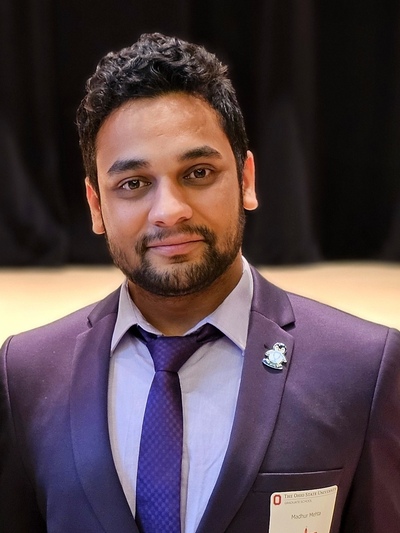
Portrait of Madhur Mehta

Heising–Simons QuRIOS Postdoctoral Fellow
University of California, Santa Barbara

Research

I study how black holes and other compact objects respond to perturbations, how near-horizon dynamics can shape that response, and how the resulting physics can be connected to scattering and gravitational-wave observables.

Black-hole response & effective theory

I use effective field theory to characterize how compact objects encode internal or near-horizon dynamics in response data accessible to an exterior observer, including tidal response, scattering, absorption, and dissipation.

A central part of this work is a finite-radius effective description that connects local gravitational response to asymptotic observables and signal predictions.

Black-hole perturbation theory & gravitational waves

I study perturbations of Schwarzschild and Kerr black holes, with particular emphasis on gauge-invariant observables, finite-frequency response, fluxes, horizon dynamics, and gravitational-wave signatures.

Current work develops gravitational response functions for Schwarzschild perturbations and extends the framework toward rotating spacetimes and waveform observables.

Near-horizon dynamics & quantum structure

I am interested in the universal dynamics of extremal and near-extremal black holes, including near-horizon throat physics and Schwarzian-like reparametrization dynamics in rotating black-hole backgrounds.

More broadly, I study whether microscopic or higher-derivative modifications of black-hole physics can leave robust signatures in scattering, compact-object response, or gravitational-wave observations.

Current Work

Black-hole response and gravitational-wave observables

I am developing a unified framework that connects compact-object dynamics to observables through black-hole perturbation theory and effective field theory. Current work focuses on finite-radius and finite-frequency gravitational response, including scattering, absorption, dissipation, tidal interactions, and their imprint on gravitational-wave signals. I am presently developing this framework for Schwarzschild perturbations and extending it toward rotating black holes.

Near-extremal Kerr and Schwarzian dynamics

A current research direction is the universal dynamics of near-extremal rotating black holes, with particular interest in the emergence of Schwarzian-like reparametrization dynamics in the near-horizon region. I am interested in how this structure is modified by higher-derivative effective-field-theory corrections and how near-horizon dynamics can ultimately be connected to black-hole response, scattering, and gravitational-wave observables.

Selected Publications

Selected work on black-hole response, strong-field gravity, black-hole thermodynamics, and microscopic structure.

Deriving Effective Descriptions and Signal Predictions for Dynamical Gravitational Systems

S. B. Giddings and M. Mehta

arXiv:2606.19435, 2026

Extreme Compactness, Extreme Gravity: Higher-Derivative Corrections to ECOs

M. Mehta

arXiv:2505.09049, 2025 · Gravity Research Foundation Honorable Mention

The Universal Thermodynamic Properties of Extremely Compact Objects

S. D. Mathur and M. Mehta

Classical and Quantum Gravity 41 (2024) 23, 235001

Electromagnetic Entrapment in Gravity

P. Heidmann and M. Mehta

Journal of High Energy Physics 03 (2024) 046

The Fuzzball Paradigm

S. D. Mathur and M. Mehta

arXiv:2412.09495, 2024

PhD Thesis — Through the Horizon and Back: Lifting the Veil on Black Hole Thermodynamics

The Ohio State University, 2025

View all publications on INSPIRE →

Apps

I build tools that make scientific research and exploration more accessible.

Naksh Lens app icon

Naksh Lens

Personalized research discovery for arXiv

Naksh Lens helps researchers find relevant new arXiv papers using a personalized Research Lens, followed authors, and research interests. It also explains why a paper may matter to the reader's current research rather than simply summarizing the abstract.

Outreach

I am interested in communicating fundamental physics through public conversations, observing programs, and informal science education.

Time Before Space YouTube channel icon

Time Before Space

Conversations on gravity, quantum theory, and fundamental physics

I created Time Before Space as a science-communication channel for long-form conversations about gravity, quantum theory, and foundational questions in physics. Guests include Juan Maldacena, Abhay Ashtekar, Gary Horowitz, Niayesh Afshordi, Sera Markoff, and Samir Mathur.

I also work as a stargazing guide with Alta Vista Tours in the Santa Barbara area, leading small-group telescope observations and introducing guests to planets, stars, star clusters, nebulae, galaxies, constellations, and the stories and physics of the night sky.